

A pool should be designed in conjunction with the house and garden. Its location, shape, roofing, heating, lighting, and technology affect not only the swimming season but also the appearance and functionality of the entire garden.
A swimming pool no longer has to be just a summer spot for swimming. In today’s single-family homes, it is increasingly becoming an integral part of the overall design of the house, terrace, and garden. Key factors include not only its size and shape, but also its orientation, view, roofing, heating, lighting, and technology.
How should you position a pool correctly, how can you extend the swimming season, and when is it worth investing in automation? Landscape architect Eliška Paták from Tempus Design answers these questions.
When is the right time to start planning a pool?
Ideally, this should happen at the very beginning of the design process for the house and garden. This is because a pool affects not only the layout of the garden, but also the patio, the views, the technology, the utility room, and the connection to the house.
What do you need to consider before building a pool?
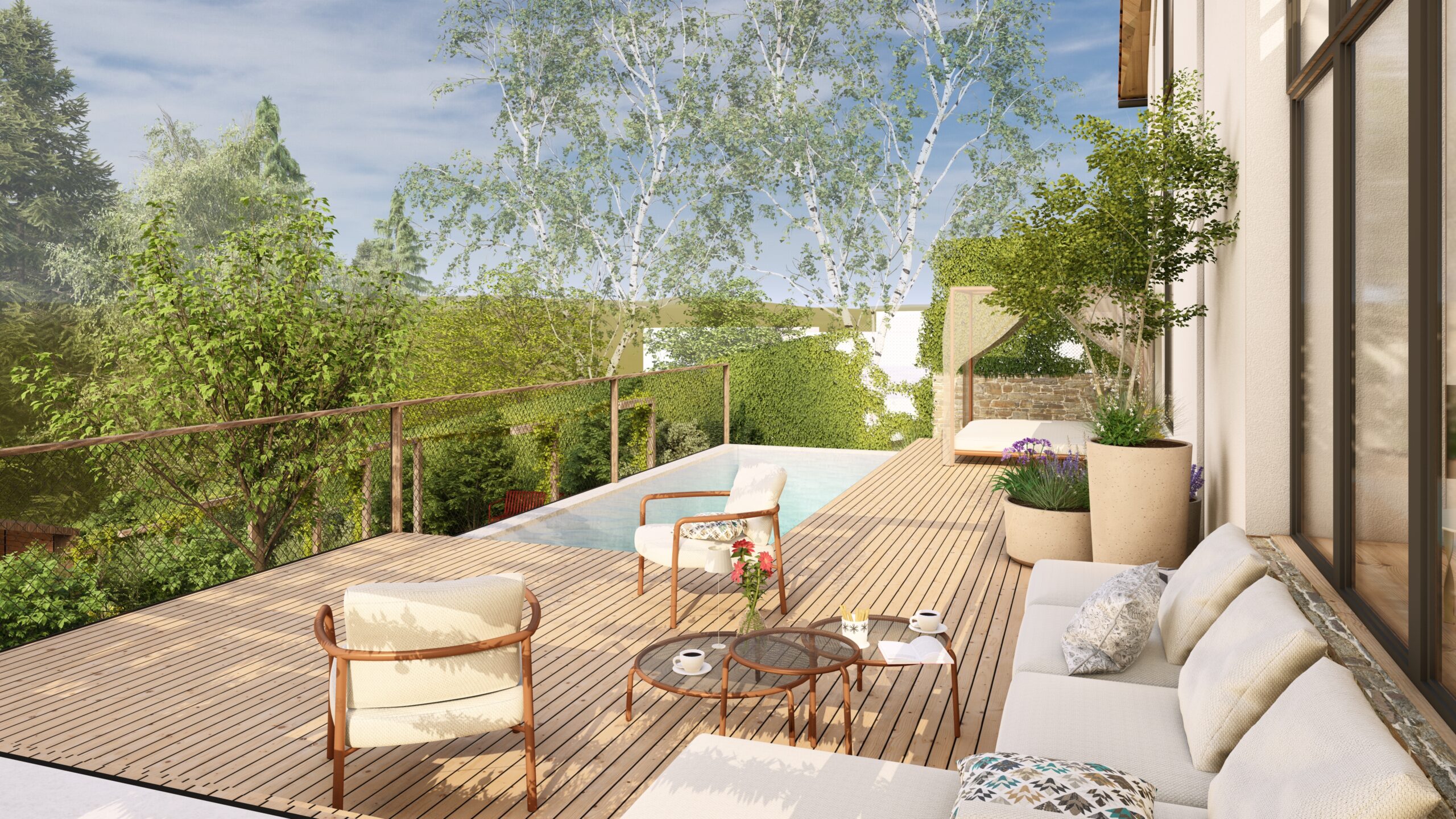
Before you start digging, you need to have everything figured out—ideally down to the last detail. The orientation of the lot is key. We want to place the pool in a sunny spot if possible, but we also need to consider the prevailing wind direction so the pool isn’t plagued by falling leaves and other debris. Today, the focus is mainly on views—both from the pool and from the house looking out at the pool—as the central feature of the garden. The connection to the house is very important—the current trend is to connect the pool directly to the living terrace adjacent to the house. In addition to all this, however, the technology involved also plays a role; there is quite a lot of it associated with a pool, and it needs to be placed somewhere and connected to the house’s utility room so that the manager or owner can maintain it conveniently.
What is the most common mistake people make when designing a pool?
When the pool is treated as the very last element of a finished garden, people often end up looking for whatever space is left over, rather than making the pool a natural part of the overall design. Another major mistake is choosing an unattractive pool enclosure, especially if the pool is visible from the house. It’s important to keep in mind that the pool is usually covered for much of the year so it can be used even on cooler days, so you need to pay close attention to the enclosure and choose one that ensures the covered pool remains attractive and blends in with the garden and the view from the house.
What shape of pool should you choose?
The shape should be based on the home’s architecture, the size of the lot, and how the space will be used. Sometimes a simple rectangle is best; other times, a more organic shape may work better. It depends on the technology chosen. We usually opt for either a rectangular shape made of concrete with a plastic liner or stainless steel. If you want a different shape, we recommend concrete. With organic shapes, however, we usually run into limitations regarding roofing options.
Why is a view of the pool from the house important?
A pool doesn't have to be just a place to swim; it can also serve as a visual feature. In some projects, its purpose is to create an attractive view from the living room or bedroom.
What role does pool lighting play?
A huge one. The pool should remain functional even in the evening, when perhaps no one is swimming in it anymore. Properly designed underwater and ambient lighting can turn the water into one of the garden’s main features.
How can I connect the pool to the patio and garden?
Today, we strive to blur the boundaries between the pool, the patio, and the garden as much as possible. The materials can flow seamlessly into one another, the edge of the pool can be part of the living area, and the entire space then feels like a single unit.
How can you extend the swimming season?
Heating is essential, as is minimizing heat loss. Today, for example, we have heat pumps, heat exchangers, and other heating methods tailored to the specific house and its energy concept.
How much can a heat pump extend the swimming season?
With a well-designed system, the swimming season can be significantly extended; however, the specific results depend on the size of the pool, its enclosure, the air temperature, the desired water temperature, and the technology used. Current systems are typically combined with a thermal enclosure, which significantly reduces heat loss at night.

Can the pool be used year-round?
A pool enclosure protects the pool from inclement weather and contamination. It reduces maintenance and operating costs because you’ll use fewer chemicals in a covered pool where debris from the surrounding area doesn’t fall in. During the off-season, it saves on energy and water heating costs. It can extend the swimming season from spring to late fall. For winter swimming, however, you’ll also need a heated room with the pool—on truly freezing days, the heat accumulated in the water isn’t enough to warm the space under the enclosure to make swimming comfortable. If you want to use the pool year-round, we recommend choosing an indoor pool, which can, of course, be partially opened for the summer.
Is it more important to heat the pool or to cover it properly?
Ideally, both are needed. A cover is very important precisely because it reduces evaporation and heat loss. Only then does it make sense to figure out how to efficiently supply the water with the necessary heat.
What technologies are available today to automate pool operations?
Today, virtually all aspects of pool operation can be automated. The system can continuously monitor water quality and, based on the measured values, automatically control water treatment, dispense the necessary chemicals, and regulate filtration. Automatic control of temperature, lighting, and pool covers is also standard.
There is also a significant difference in the method of water treatment itself. In addition to traditional chlorination, you can use, for example, a salt chlorinator, which produces chlorine through the electrolysis of salt water. However, there are other water treatment systems that can significantly simplify the entire process.
Today, all of these features can be integrated into a smart home system and controlled via an app. For example, the owner can remotely check the pool’s status, adjust the temperature, or set the lighting. In luxury projects, however, it is especially important to us that technology not be an end in itself. The goal is for the pool to operate as automatically as possible, requiring the owner to do as little as possible to maintain it.
Is it worth investing in more expensive pool technology?
As a general rule, the technology should be appropriate for the intended use and size of the pool. It’s a good idea to opt for higher-quality equipment, but there’s no point in oversizing the pool unnecessarily when it comes to technology. That, too, can have an unnecessary negative impact.
How can you have a pool without unnecessary worries and maintenance?
Ideally, before the actual design and construction, you should consider what the client wants from the pool, how often they’ll use it, and how much time they’re willing to devote to it. Sometimes, the client comes to the conclusion that they’d like a pool, but ends up choosing, for example, a hot tub, a swim spa, or just an outdoor shower—all of which require a different kind of maintenance.
The TV Series "The Garden"
It doesn't have to be just a pool— in the previous installment, we discussed ponds, water features, and rainwater management. Next in the series: smart gardens and technology. You can find examples of these projects in the Gardens section.
Tempus Design Studio
Are you thinking about adding a pool to your new garden?
The best results are achieved when the pool, house, patio, and garden are designed as a single, cohesive whole. Tempus Design specializes in comprehensive garden design and integrating gardens with the architecture of the house.
Frequently Asked Questions
When should you start planning a pool?
Ideally, this should be considered as early as the design phase of the house and garden. A pool affects the layout of the garden, the patio, the views, the technology, and the connection to the house.
Where should I put a pool in my yard?
When designing a home, it is important to consider the orientation of the lot, ample sunlight, prevailing wind patterns, views from the house, and access to the patio.
How can you extend the swimming season for your pool?
Heating systems—such as heat pumps—can help, as can, above all, high-quality roofing, which reduces heat loss and evaporation.
Can a pool be used year-round?
Yes, but an indoor pool is best suited for truly year-round use. An outdoor, covered, and heated pool can significantly extend the swimming season, especially from spring through late fall.
What pool technologies can be automated?
For example, you can automate water monitoring and treatment, filtration, temperature, lighting, and pool covers. The technology can also be integrated with a smart home system.
Is a rectangular pool better, or an oval one?
It depends on the house's architecture, the size of the lot, the intended use, and the chosen technology. With organic shapes, the roof, for example, may be a limiting factor.
How can you reduce the amount of pool maintenance required?
It is important to consider in advance how the system will be used and to choose technology that is appropriate for the pool's operation. Automation can significantly simplify a number of tasks.